
Autoimmune Disease and the Gut-Immune Connection
If you have an autoimmune diagnosis, someone has probably told you to fix your gut. It is one of the most repeated pieces of advice in this space and one of the least well explained. The part that is solidly true: a large share of your immune tissue sits in and around your intestinal lining, so gut health and immune behavior are genuinely connected. The part that gets oversold: that healing your gut resolves autoimmune disease. It does not, and nothing on our autoimmune disease support page is offered as a replacement for the specialist managing your condition.
Why the gut and the immune system are so tangled
Your intestinal lining is one cell thick in places. On one side is everything you eat and every organism living in your gut. On the other side is you.
That thin barrier is patrolled by an enormous amount of immune tissue, because it is where your body does most of its deciding about what is harmless and what is a threat. Immune cells there are constantly sampling what passes through and calibrating the response. It is the busiest immune training ground in the body.
So an immune system behaving unpredictably and a gut that is inflamed or barrier-compromised often show up in the same patient. What is much harder to establish is which one started it.
What "leaky gut" actually means, and where the story gets shaky
The clinical term is increased intestinal permeability, and it is a real, measurable thing. The junctions between the cells lining your intestine can loosen, and when they do, molecules that would normally stay in the gut can cross into circulation.
Increased permeability has been documented in several autoimmune conditions, celiac disease and type 1 diabetes among them. That much is published and not controversial.
The popular version goes further than the research does. The internet story says that leaky gut causes autoimmune disease, that a specific supplement protocol seals it, and that sealing it puts the disease into remission. What the evidence supports is more limited: permeability and autoimmune activity travel together, and researchers are still working out how much of that is cause, how much is consequence, and how much is both feeding each other. Anyone selling you certainty here is ahead of the science.
Molecular mimicry, the mechanism worth understanding
The one proposed mechanism with genuine research behind it is molecular mimicry.
The idea is straightforward. Your immune system learns to recognize a threat by its shape. If a piece of a bacterium or a food protein happens to resemble a protein in your own tissue closely enough, an immune response trained on the invader can end up recognizing your tissue too.
It is a well-documented phenomenon in a handful of conditions, and it gives a plausible route from gut exposure to immune confusion. It is also not a complete explanation for autoimmune disease, and it does not mean every food you react to is attacking your joints.
Where absorption becomes the practical problem
This is the part that brings most autoimmune patients to us, and it has nothing to do with theories.
If your gut is inflamed, you often absorb poorly. If you absorb poorly, the supplements you are dutifully taking may not be reaching your bloodstream in useful amounts. Patients arrive with a shelf of bottles, a good diet, and lab work that still shows low nutrient status.
Add in the medications many autoimmune patients take, several of which affect nutrient status directly, and it is common to find real deficiencies in someone doing everything they were told to do.
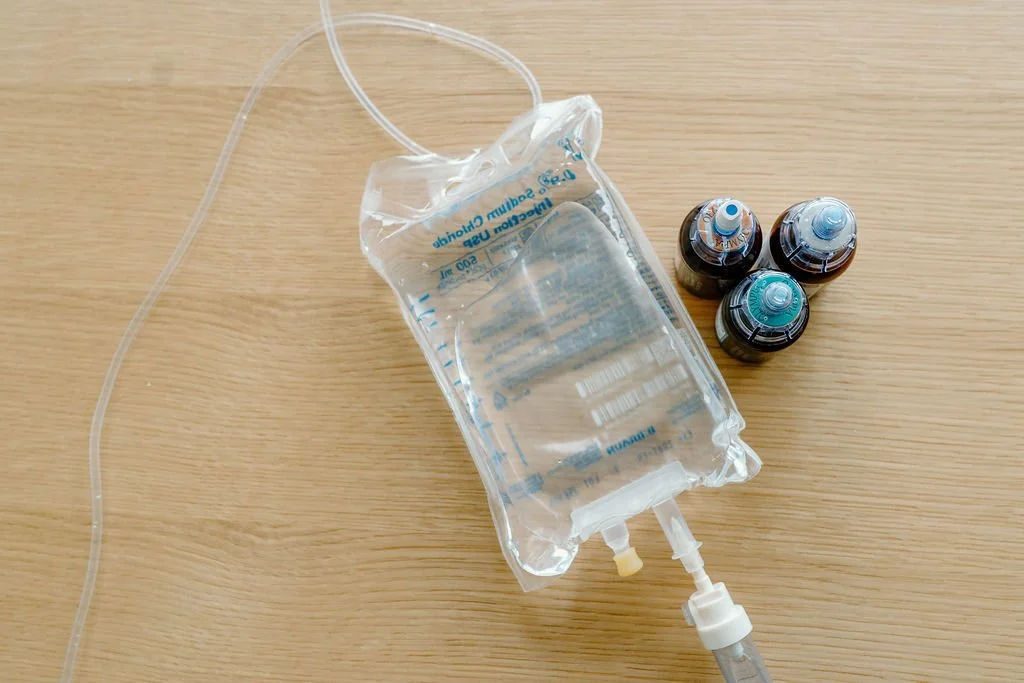
IV delivery solves one narrow piece of that. It does not depend on your gut. It is not better than oral supplementation for everybody, and we say so to plenty of patients. For someone with documented low levels and a gut that is not cooperating, it is the difference between taking something and actually getting it.
Our earlier piece on IV therapy for autoimmune disease walks through how that plays out in practice.
Testing before guessing
We would rather find out than assume. Lab testing can show nutrient status, inflammatory markers, and in some cases food sensitivity patterns, which is what turns a generic bag into an actual plan.
Two honest notes on testing. Food sensitivity panels are useful as a starting point for a conversation, not as a verdict, and they are not the same as allergy testing. And a nutrient panel tells you what is low today, which means retesting matters more than most people expect.
If you have been taking supplements for a year and never had levels checked, that is the place to start. Call (918) 265-4811 and ask what testing would tell you something new.
What we do and do not do for autoimmune patients

We do not manage autoimmune disease. Your rheumatologist, gastroenterologist, endocrinologist or whoever holds your diagnosis manages it, including any immune-modulating medication. We do not adjust that, second-guess it, or suggest you come off it.
What our providers do is nutrient and hydration support built from your labs, and where appropriate therapies aimed at oxidative load, glutathione among them. Patients dealing with gut repair specifically sometimes ask about peptides, which we covered in BPC-157 for gut health and injury recovery. The full list of what we deliver and who it suits is on our advanced IV therapy page.
Flares are the other thing worth mentioning. IV support does not stop a flare and we will not pretend it does. Some patients find it useful to have a plan for the depleted stretch afterward rather than white-knuckling through it.
Coming in from Owasso and the Tulsa area
Most autoimmune patients we see have been at this for years and have heard a lot of confident claims that did not pan out. We try to be the clinic that tells you what is uncertain.
If you want to know whether nutrient support would change anything in your situation, book a consultation or call (918) 265-4811. Bring your recent labs and your medication list. If the honest answer is that your money is better spent elsewhere, we will say that.
Frequently asked questions
Is leaky gut a real diagnosis? Increased intestinal permeability is a real, measurable phenomenon and it has been documented in several autoimmune conditions. "Leaky gut" as a stand-alone diagnosis that explains and resolves autoimmune disease is not established. Both things are true at once.
Will fixing my gut put my autoimmune disease in remission? There is no evidence that supports promising that, and we will not promise it. Supporting gut and nutrient status is worth doing on its own terms. Your disease management stays with your specialist.
Why would I need IV nutrients if I already take supplements? Because inflamed guts absorb poorly, and several common autoimmune medications affect nutrient status. Some patients take everything correctly and still test low. IV delivery skips the absorption question. If your levels are fine, you do not need it.
Can IV therapy stop an autoimmune flare? No. It does not stop or shorten a flare. Some patients use nutrient support to recover from the depleted state a flare leaves behind, which is a different and more modest claim.
Do I need a diagnosis before coming in? It helps a lot, because it tells us what is already being managed and by whom. If you have symptoms and no diagnosis, the more useful first step is a proper workup, and we will point you that way.
Double-click to edit...
